
What happens when a BIM team joins a project after construction has already begun?
Studies show that over 35% of project delays in adaptive reuse developments come from late-stage clashes between new MEP systems and existing installations—a risk that grows even bigger when the building is a historical landmark undergoing a major transformation.
This raises an important question:
How did PSK BIM deliver precise LOD 350 plumbing, HVAC ductwork, and mechanical pipeline models for the Google Pier 57 redevelopment despite multiple pre-installed MEP systems already blocking design pathways?
This case study reveals the exact BIM workflow that resolved this challenge—closing the loop on how a near-impossible coordination scenario was turned into a successful delivery.
Reviving a Landmark While Construction Was Already Underway
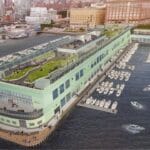
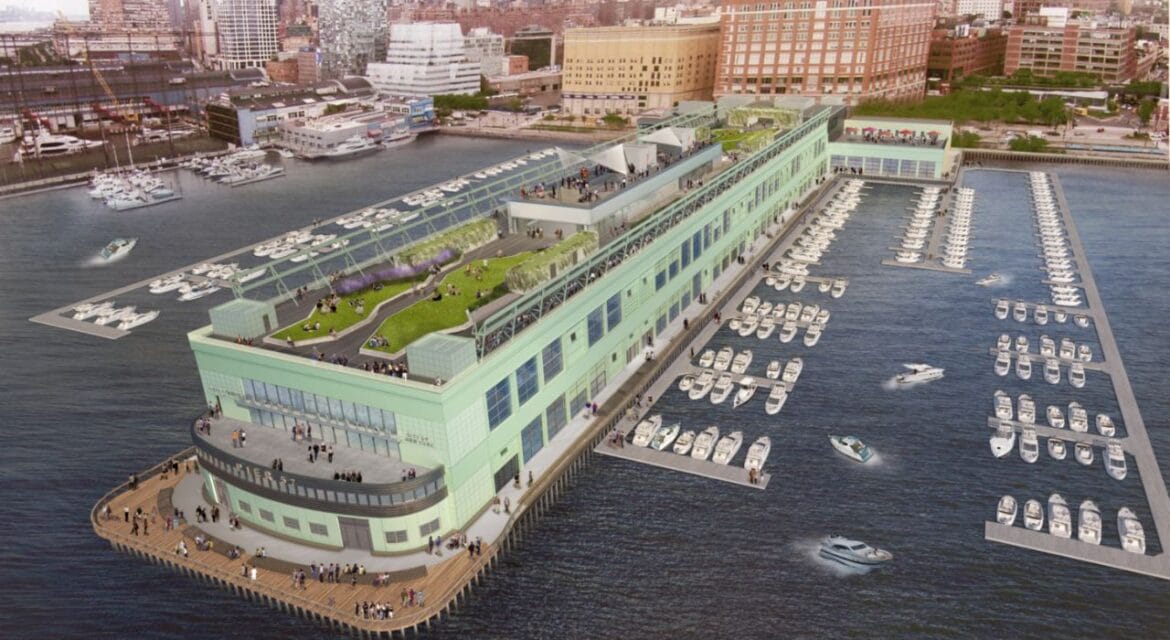
The Google Pier 57 project in New York City, USA, is one of the most ambitious adaptive-reuse developments on the Hudson River. Once a historic, vacant cargo facility, the structure was being transformed into a mixed-use waterfront destination featuring:
- Google’s new 400,000 sq. ft. office
- Public rooftop park (two acres)
- Market 57 food hall curated by the James Beard Foundation
- The Living Room – a 7,400 sq. ft. public gathering space
- Show kitchen and multi-use event spaces
This redevelopment required modern building systems to be integrated into a structure originally never meant to accommodate today’s MEP complexity.
PSK BIM was engaged to deliver:
- Plumbing modeling.
- HVAC ductwork modeling.
- Mechanical pipeline modeling.
- At BIM Level: LOD 350.
- Using AutoCAD 3D MEP.
- Within a 3-month Timeframe.
However, the team joined at a complicated stage. Construction had already begun, and several MEP components were already installed physically on-site. This meant the BIM environment would not match the reality on the ground.
Core Problem: Mid-Construction MEP Installations Blocking the New BIM Workflow
“Some of the MEP elements, like duct, pipeline, and conduit, were already installed, which caused a little hazard in our workflow.”
This is a serious issue because:
- Installed elements may not be documented properly.
- Existing site conditions may differ from earlier drawings.
- New MEP layouts risk clashing with what is already built.
- Rework becomes expensive and time-consuming in historic structures.
The project demanded precision, coordination, and a fully updated model to avoid clashes and delays.
Deliver Accurate LOD 350 MEP Models Under Real-Site Constraints
PSK BIM’s responsibility was to:
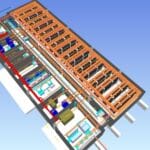
- Develop full LOD 350 plumbing, HVAC ductwork, and mechanical pipeline models.
- Use AutoCAD 3D MEP for modeling as specified.
- Incorporate existing pre-installed elements into the updated BIM model.
- Ensure a clash-free layout that works with the real-site conditions.
- Complete the entire scope within 3 months.
The key task was not just modeling, but modifying the BIM workflow to reflect reality—a complex challenge in adaptive reuse projects involving historical structures.
The expectation from the client was clear:
A fully coordinated, accurate, constructible MEP model that matched what had already been installed, without causing disruptions.
Rebuilding the Model Using a Ground-Reality–First Workflow
To address the complications created by pre-installed MEP systems, PSK BIM had to redesign its approach entirely.
The project file describes the decisive step in a single sentence:
“PSK BIM moved with a new plan and prepared a new model with those existing parts and delivered the best work output.”
1. Capturing Existing Site Conditions Accurately
The first action was to gather precise information about:
- Already-installed ducts
- Existing pipelines
- Installed conduits
- Space constraints around the historic building structure
This included cross-checking available drawings against real-site conditions to create the exact as-built geometry inside AutoCAD 3D MEP.
2. Rebuilding the Model Around Installed Elements
Instead of forcing the original design intent, PSK BIM:
- Created a fresh LOD 350 BIM model that respected the existing installations.
- Re-routed plumbing and mechanical lines to avoid clashes.
- Reorganized duct paths where space was already occupied.
- Ensured all new MEP elements aligned with structural and architectural constraints.
This approach ensured that the BIM model became:
- A true reflection of the site
- A practical construction guide
- A coordination tool for upcoming MEP work
3. Utilizing AutoCAD 3D MEP for System-Level Coordination
Using the software specified in the project file, PSK BIM:
- Re-modelled plumbing and pipelines using the real-dimensional data.
- Adjusted ductwork geometry based on actual installation heights.
- Coordinated elevations, offsets, and equipment positions.
- Updated the entire MEP layout at LOD 350, enabling:
- Detailed system visualization
- Conflict prevention
- Accurate fabrication guidance
4. Maintaining Project Delivery Within the Compressed 3-Month Timeline
Despite having to rebuild the model and adapt to an already-active construction environment, the team worked in stages and delivered on time.
This involved:
- Rapid iteration cycles
- Daily clash review routines
- Continual coordination updates
- Regular communication with project stakeholders
A Fully Coordinated LOD 350 MEP Model Delivered Successfully
Although the original file does not mention numerical ROI or quantifiable savings, the results are clearly reflected through the successful completion.
According to the provided content:
- PSK BIM completed the plumbing, HVAC ductwork, and mechanical pipeline models.
- The team successfully integrated all existing pre-installed MEP elements.
- The new plan ensured a seamless workflow, eliminating the hazards originally caused by incomplete coordination.
- The output was delivered within the 3-month timeframe.
Key Achievements:
- Accurate LOD 350 models aligned to real-site conditions
- Effective coordination with previously installed MEP systems
- Zero disruption to ongoing construction
- High-quality deliverables using the specified software (AutoCAD 3D MEP)
- Support for a landmark redevelopment project
This allowed the Google Pier 57 redevelopment to move forward smoothly, ensuring the MEP systems aligned perfectly with both historic constraints and modern functional requirements.
How the ‘New Plan’ Solved a High-Risk Challenge
How did PSK BIM solve the challenge of delivering LOD 350 MEP models when several systems were already installed mid-construction?
The answer is now clear:
By rebuilding the entire model around the real, on-site conditions, PSK BIM transformed a risky situation into a coordinated success—delivering accurate, construction-ready BIM outputs for a complex and historically significant project.
This case demonstrates a major takeaway for BIM Managers and AEC professionals:
When construction has already begun, the fastest path forward is not resisting reality—but modeling directly from it.
PSK BIM’s approach at Google Pier 57 stands as a strong example of adaptive BIM methodology delivering high-value results in a live construction environment.
If you’re looking for a reliable BIM partner who can step in at any stage of the project and deliver accurate, clash-free models, PSK BIM Service is ready to support you. Reach out to our team today and let’s build smarter together.